On this page +
Provisional review · demo build
County of Fortune is trying to do something genuinely different: make the county, not the city, the thing you manage. The demo shows that the idea is more than a marketing line. It also shows where the game still needs work before it can stand beside the best medieval builders.
Provisional score
8/10
Based on the public demo and official systems documentation. This is not a final Early Access review; balance and performance may change at launch.
What works
- County-scale planning feels distinct
- Production chains are readable and satisfying
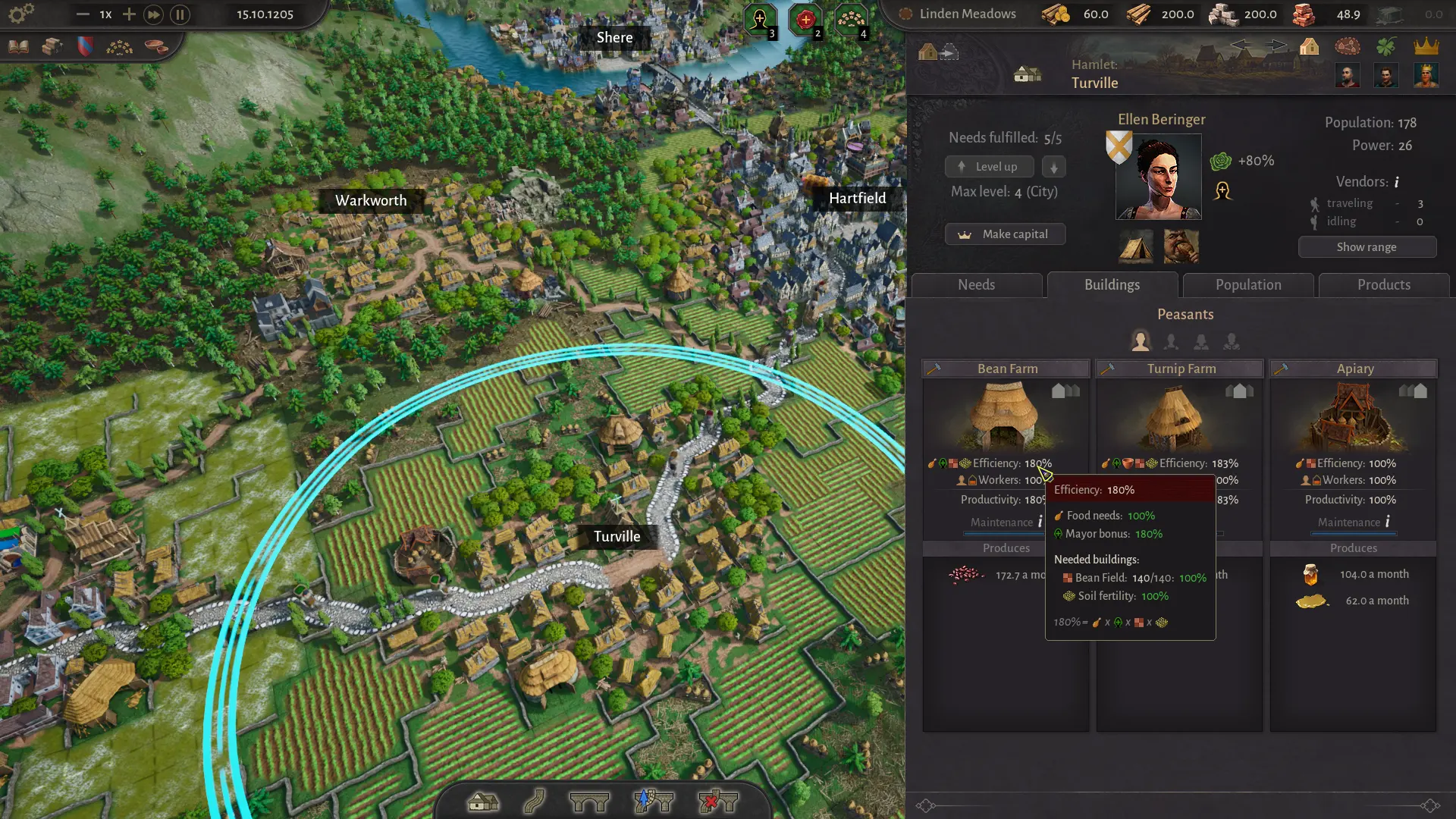
- Mayors and houses add real texture
- Demo progress carries into launch
What needs work
- Onboarding assumes too much
- Trade and input problems are opaque
- UI density fights the scale
- Late-game performance is unproven
The county scale works
The best decision in County of Fortune is the one in its title. By making settlements the unit you place, the game avoids the tedium of drawing every house and replaces it with a more interesting question: what should this place become?
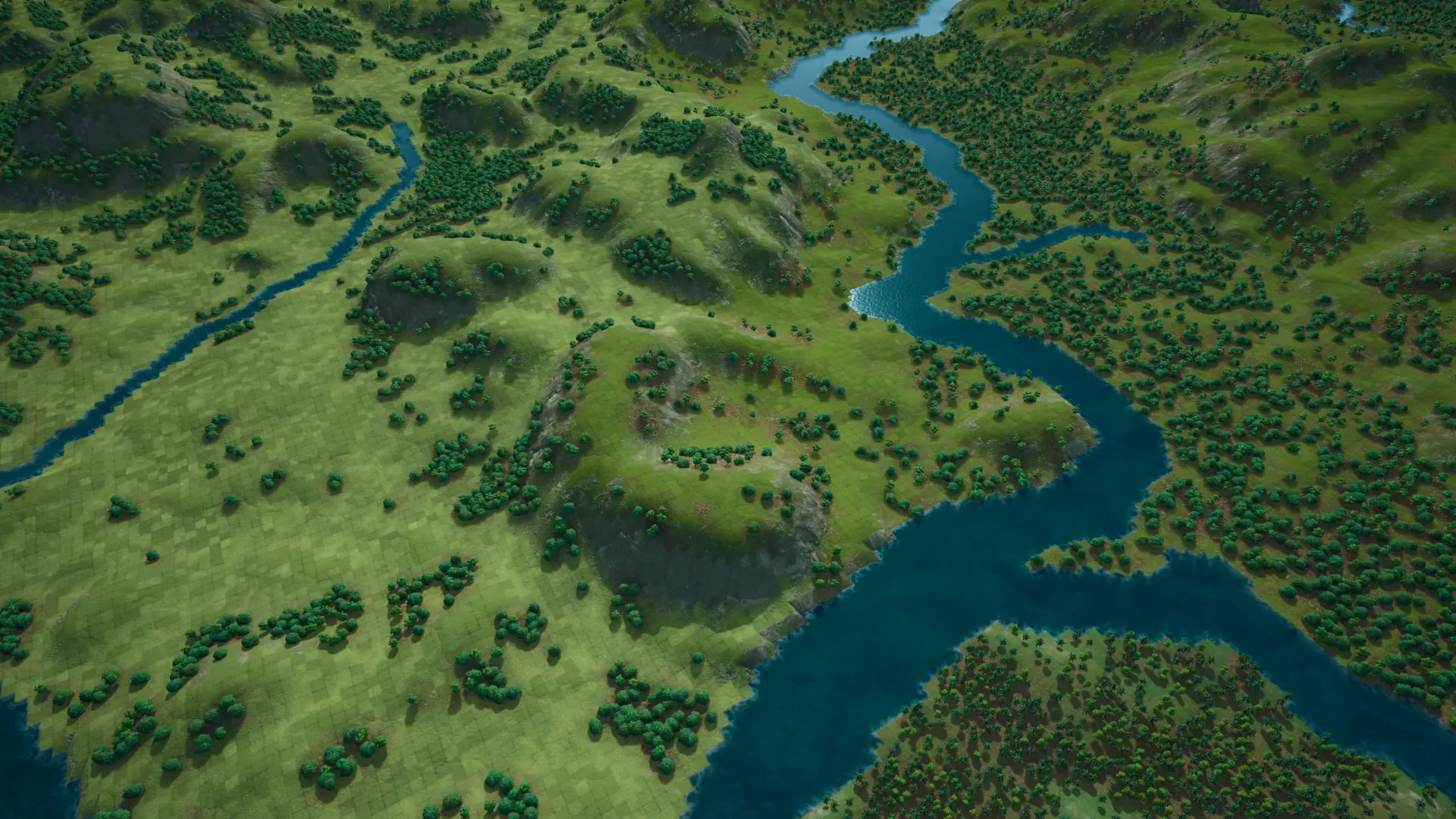
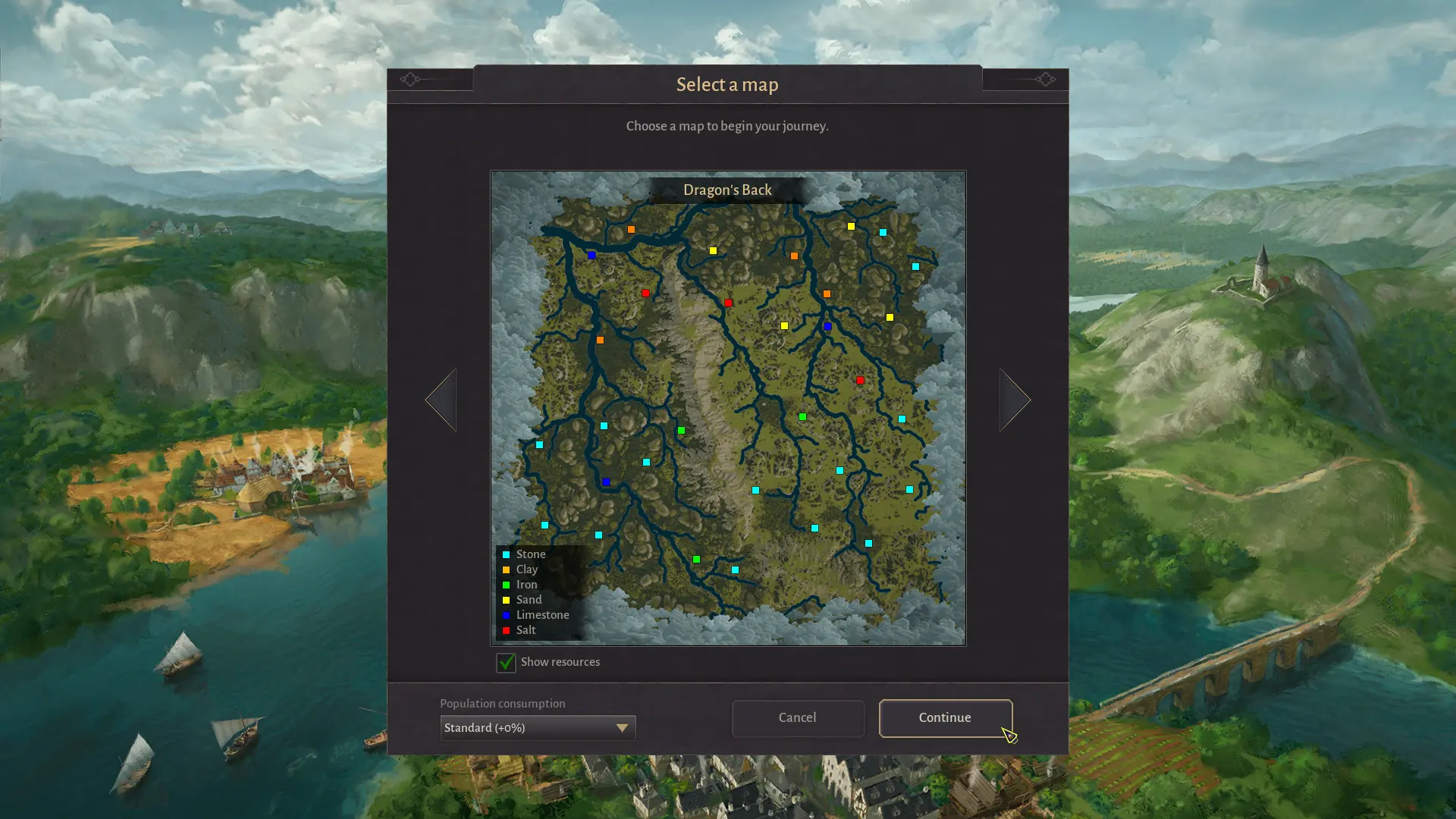
Settlement sites are shaped by terrain. A river bend is a logistics opportunity, a stone deposit is an industrial one, and a patch of fertile soil decides whether a settlement can feed itself. Because settlements grow procedurally, the map fills in around your decisions rather than requiring constant manual decoration.
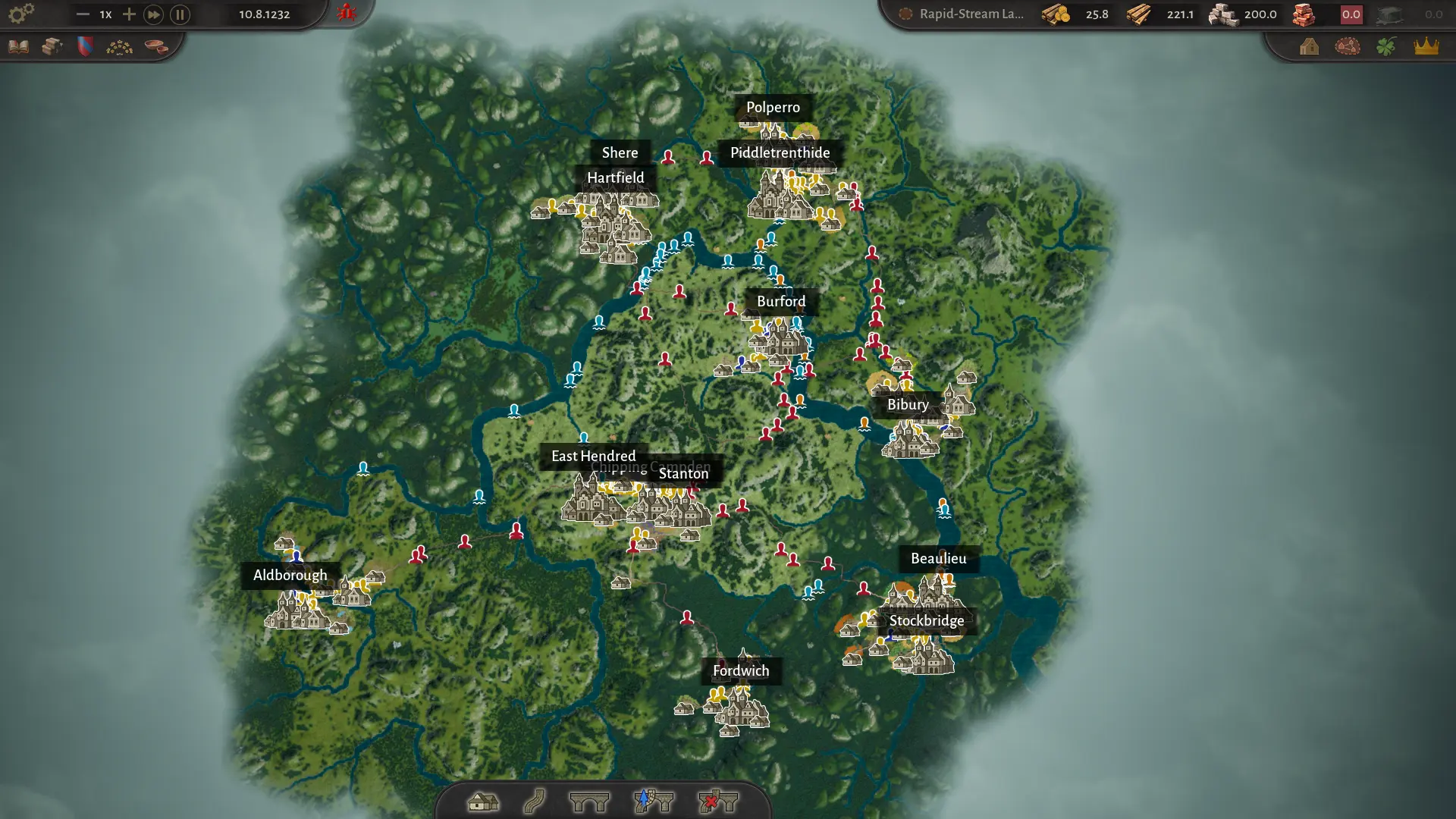
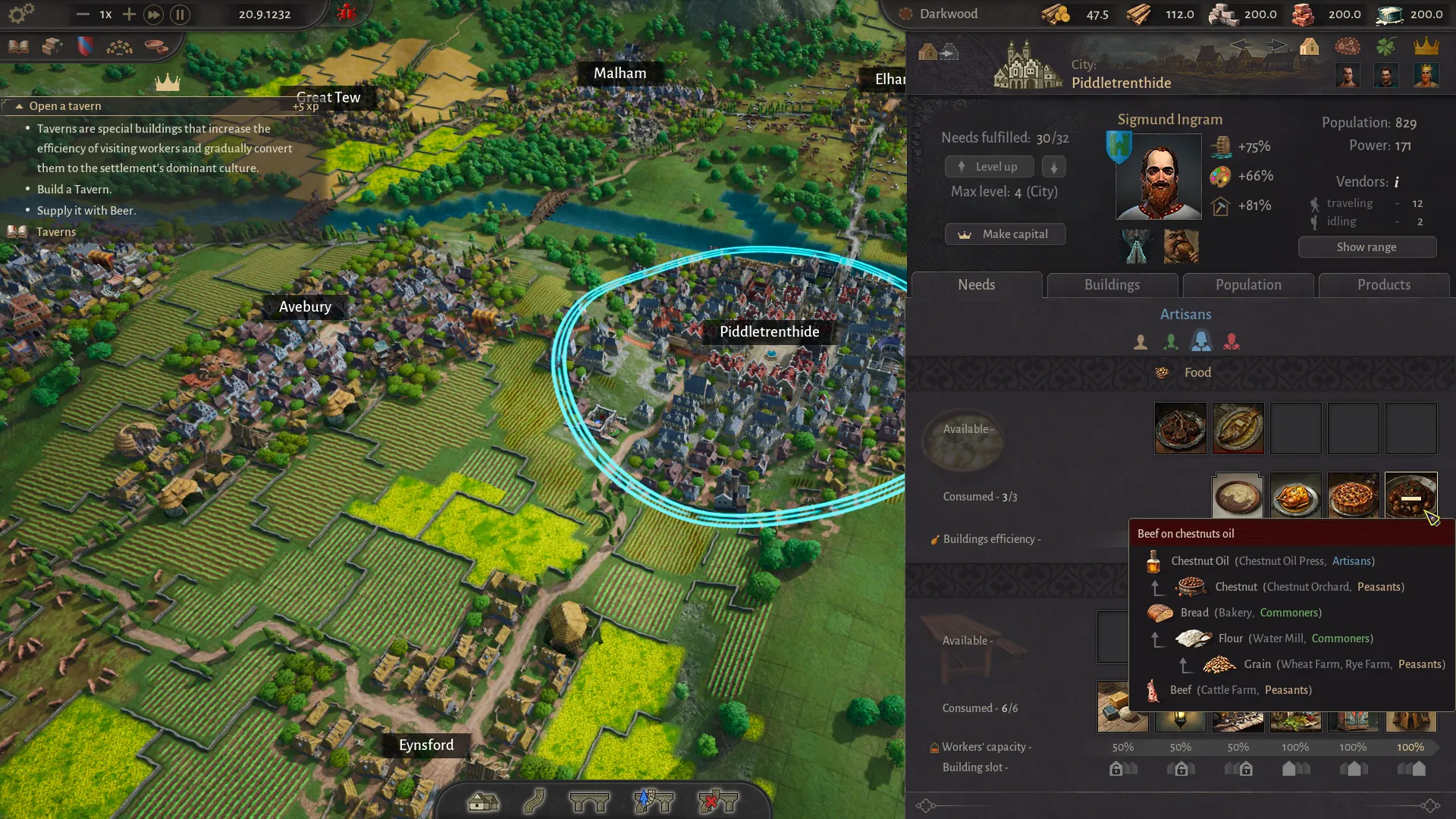
The zoomed-out view is the point. You are not admiring a single town square; you are reading a region. That shift in perspective is the game’s strongest idea and the main reason to try the demo.
An economy worth reading
The production chains are the second pillar. Raw goods are refined into advanced goods across real chains: grain becomes flour and bread, logs feed carpentry and wooden chests, stone supports masonry and upgraded roads, clay feeds pottery and brickmaking. Higher social classes demand more complex food and equipment, which pushes you to specialise settlements rather than build the same generic town four times.
The demo’s trade screen is a good sign. It shows exports, imports and route volumes in a way that lets you diagnose a region rather than guess. The inclusion of heavy goods that must travel by river is exactly the kind of geographic constraint a county builder needs.
The weak point is legibility. When a workshop is idle, the game shows an input warning, but the path from “missing input” to “which settlement, which route, which building” can still take too many clicks. The new tooltips and production-chain arrows help; they do not fully solve it.
Start at the final good and work backwards through every input. If a settlement needs bread, confirm the grain, flour and bakery are all present, staffed and connected. Most “bugs” are a missing link in that chain.
Mayors and politics give the county a pulse
Named mayors with production bonuses are a smart addition. They turn a generic farm into a place with a person attached, and the ability to swap mayors freely makes the system about optimisation rather than punishment. The August 2026 rebalance removed negative bonuses and swap penalties, which is the right call for a game that already asks a lot of the player.
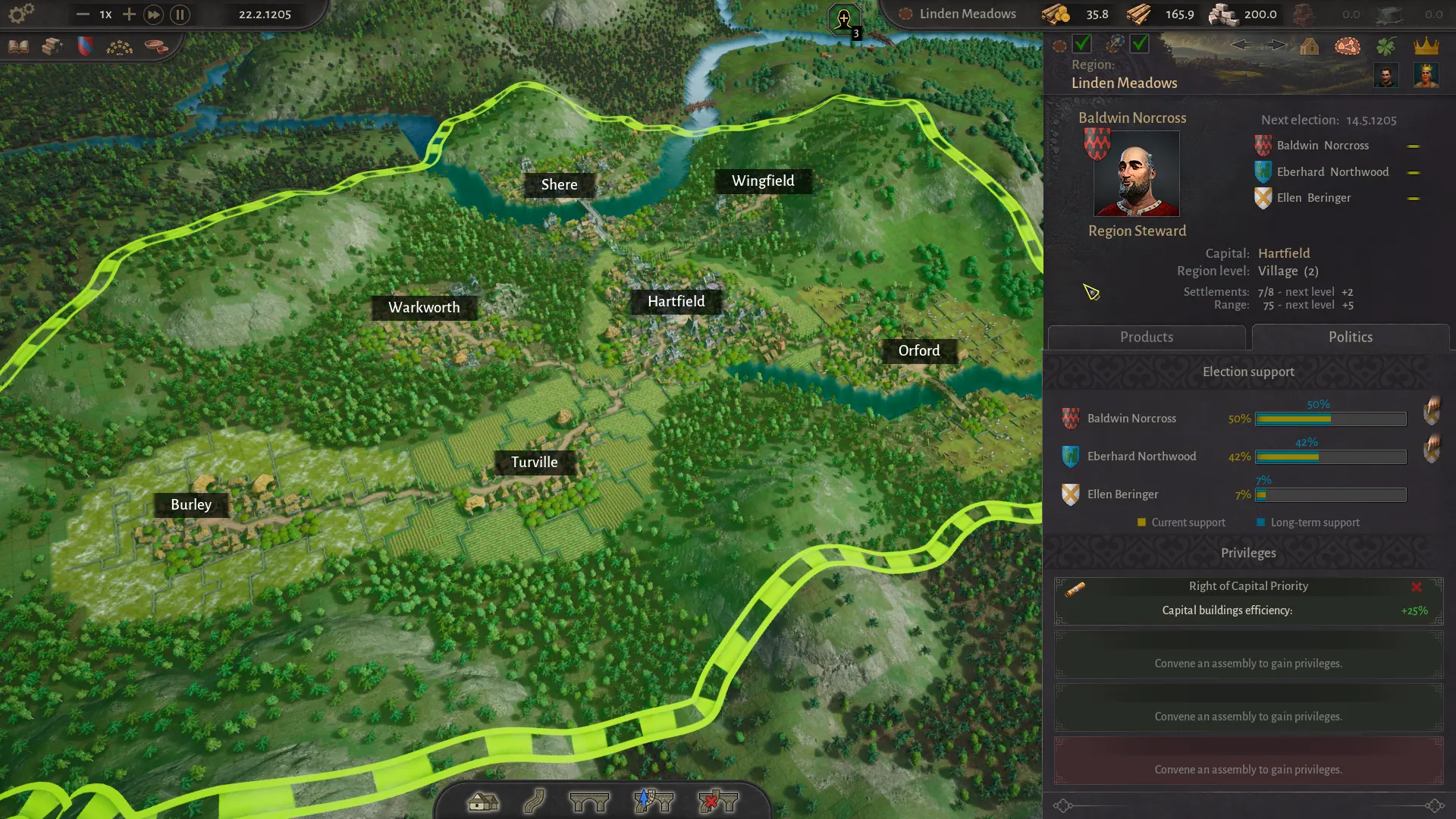
Noble houses and the Assembly are more ambitious. Elections, influence, privilege proposals and corruption give the late game a political layer that most city builders lack. In the demo, the system is understandable but not yet deeply tested; the long-term question is whether the choices remain interesting after the tenth election.
Cultures are the most intriguing system and the hardest to judge from a limited demo. Traditional Products, population share and synergy traits create a real reason to care about who lives where. The rework toward six Traditional Product slots is a clear improvement over a passive bonus.
Where it fights you
The demo’s onboarding is the biggest barrier. The tutorial tells you to place a settlement but does not always make it obvious that you must select a starting building in the left panel first. A red placement marker can mean overlapping settlement radii, missing a resource area, or standing on a tiny stone patch. The game has improved these messages, but a new player can still lose ten minutes to a problem the UI should explain in one sentence.
The interface is dense. That is expected for a management game, but the combination of tiny tooltips, nested panels and a zoomed-out camera can be exhausting on a 1080p monitor. The recent quality-of-life work — closing windows with Esc or right-click, clearer construction points, carrying capacity on walkers — shows the team knows this. It needs to go further before launch.
Trade is the other friction point. Raft ports only move goods downstream in the demo, heavy goods cannot travel by road between regions, and a raft port can receive land trade only if the sending region has a small market. These are good rules; they are not always obvious when a route silently fails.
Performance and polish
On paper, the requirements are modest. In a large county, the simulation has to track many settlements, vendors and production buildings at once, so the CPU matters more than the GPU. The demo’s smaller scale makes it hard to judge late-game performance; that is the biggest unknown for the Early Access launch.
Visually, the game has a coherent identity. The medieval grid, muted terrain and parchment-and-gold UI fit the subject, and the procedural towns look believable from a distance. It is not trying to be a screenshot generator like Manor Lords, but it knows what it wants to be.
Who should play County of Fortune?
Play it if you like Foundation’s economy, Songs of Syx’s scale or the idea of a medieval builder with a political layer. You enjoy planning supply chains, naming settlements and watching a region become greater than the sum of its villages.
Wait if you need a polished campaign, tactical battles or a complete tutorial. Early Access is the right place to learn the game, but it is still an unfinished product. Our roadmap page explains what is planned.
For a practical start, read the beginner guide. If you are still deciding, the free demo is the honest review: it costs nothing and your county carries over.
Quick answers
County of Fortune review questions
Is County of Fortune worth buying at Early Access launch?
If you enjoy regional economy builders and are comfortable with an unfinished game, the demo makes a strong case. The county scale and production chains are already distinctive. If you need a polished, complete campaign, wait for the full release.
Is County of Fortune like Manor Lords?
Only at the medieval theme level. Manor Lords focuses on one detailed town and tactical battles; County of Fortune focuses on multiple settlements, regional logistics and noble-house politics. Our similar games page compares both.
Does County of Fortune have combat?
No military combat system has been announced. Conflict is economic and political: rival houses, elections, privileges and regional pressure. The builder remains the core of play.
How much content is in the demo?
One map, the tutorial, settlement levels 1–2, the Commoner class and the core production, trade, mayor and culture systems. It is enough to understand the loop, not enough to see the full Early Access content.