On this page +
Resources & goods
County of Fortune’s goods chain runs from deposits and fields to workshops and luxury cabinets. This reference lists the resources and products seen in the demo, grouped by what they do for a county. Early Access adds more than 50 products, so the catalogue will grow.
Map resources
The map selection screen can display resource deposits. These determine which settlements can specialise in extraction and heavy industry.
Stone
Quarries, masonry, stone roads
Clay
Bricks, pottery, ceramic goods
Iron
Steel and metal production
Sand
Glassworks and glassware
Limestone
Construction and processing
Salt
Food preservation and trade
Deposit types shown in the demo map legend. Exact uses and recipes can change during Early Access.
Raw and agricultural goods
| Good | Source | Main use |
|---|---|---|
| Grain | Wheat Farm, Rye Farm | Flour, bread, composite food |
| Cabbage / Turnips / Beans / Lentils / Buckwheat | Farms | Basic food and food variety |
| Chestnuts | Chestnut Orchard | Chestnut oil and Artisan food |
| Beef / Lamb / Chicken | Pastures and farms | High-value food |
| Honey | Apiary | Food and trade good |
| Fish | Fishery | Food |
| Wool | Sheep Farm | Wool tunics and clothing |
| Logs | Logging Camp | Carpentry, wooden chests, construction |
| Stone | Stone Quarry | Masonry, stone roads, construction |
| Clay | Clay Pit | Bricks, pottery, ceramic goods |
| Sand | Sand deposit | Glassware |
| Iron | Iron deposit | Steel and metal goods |
| Plum / Mustard Seed | Farms and orchards | Food, oil, mustard and trade goods |
Food and processed goods
Food is the first need and the first chain. Basic crops keep a settlement alive; processed food supports Commoners, Artisans and Patricians. The demo trade list includes bread, cheese, butter, sausages, chestnut oil and other processed foods.
- Flour — milled from grain; input for bread.
- Bread — baked from flour; a reliable higher-value food.
- Cheese and butter — dairy processing; food variety and trade.
- Sausages — processed meat; a higher-class food.
- Chestnut oil — pressed from chestnuts; used in composite Artisan dishes.
- Beer — tavern input; supports worker efficiency and culture conversion.
- Mustard — condiment and trade good seen in the demo list.
A settlement with two reliable foods will outperform one with five intermittent foods. Stabilise each chain before adding the next, and check the Needs panel after every change.
Construction goods
| Item | Produced by | Used for |
|---|---|---|
| Logs | Logging Camp | Carpentry points, wooden chests, building costs |
| Stone | Stone Quarry | Masonry points, stone roads, advanced buildings |
| Clay | Clay Pit | Bricks and pottery |
| Bricks | Brickmaker | Higher-tier construction |
| Carpentry points | Carpenter’s Guild | Building and road maintenance |
| Masonry points | Mason’s Guild | Stone construction and road upgrades |
Equipment and clothing
Equipment is the second core need. Supplying it unlocks building slots and, at level two and above, raises worker capacity. The demo shows wooden chests and wool tunics as the early equipment chain; later classes require higher-tier clothing and goods.
- Wooden Chests — logs → workshop; early equipment.
- Wool Tunics — wool → workshop; alternative early equipment.
- Leather Surcoats — leather → workshop; higher-tier clothing.
- Soap — a luxury/hygiene good for higher classes.
- Medicine — high-tier need and trade good.
Luxury goods
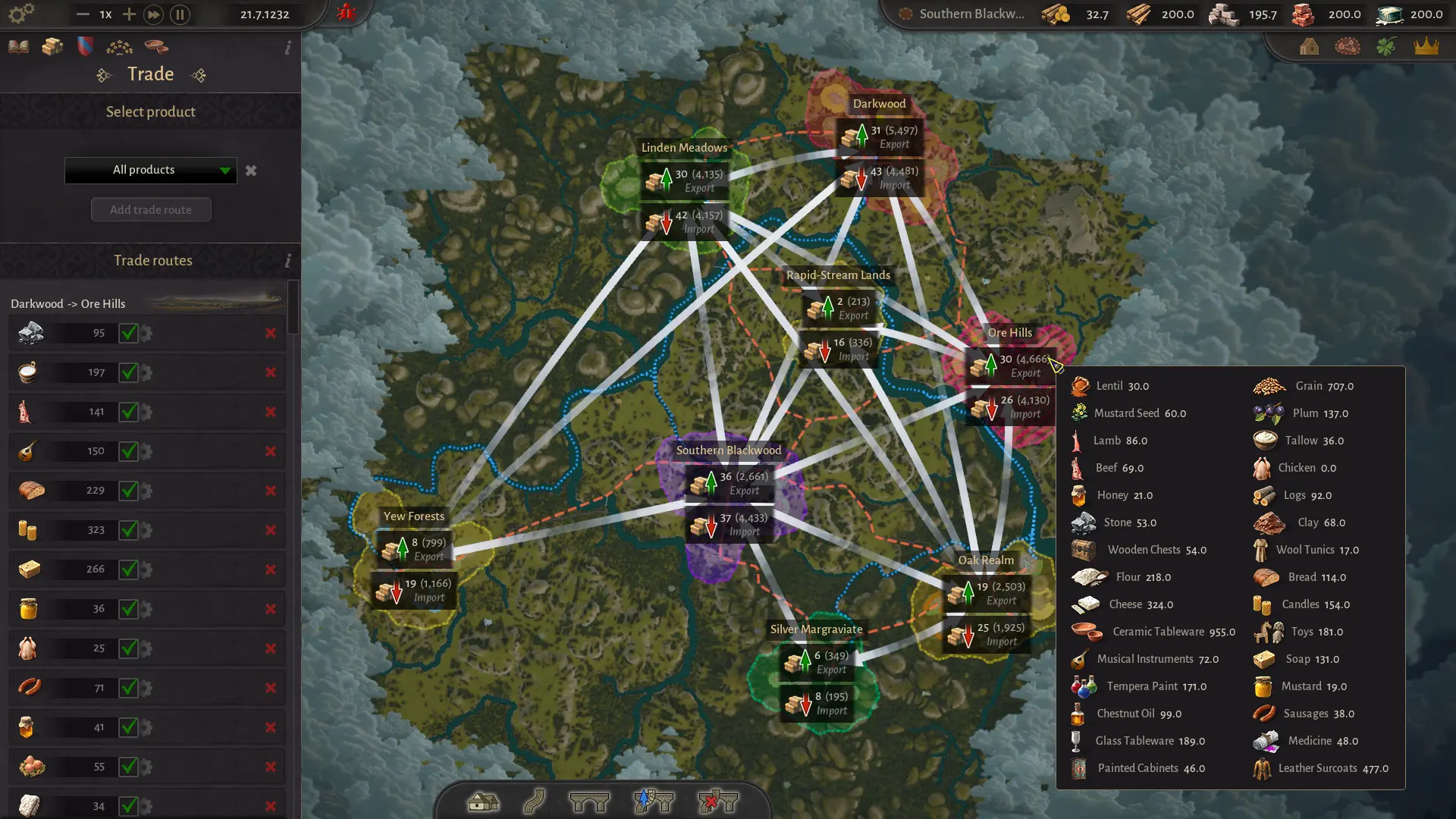
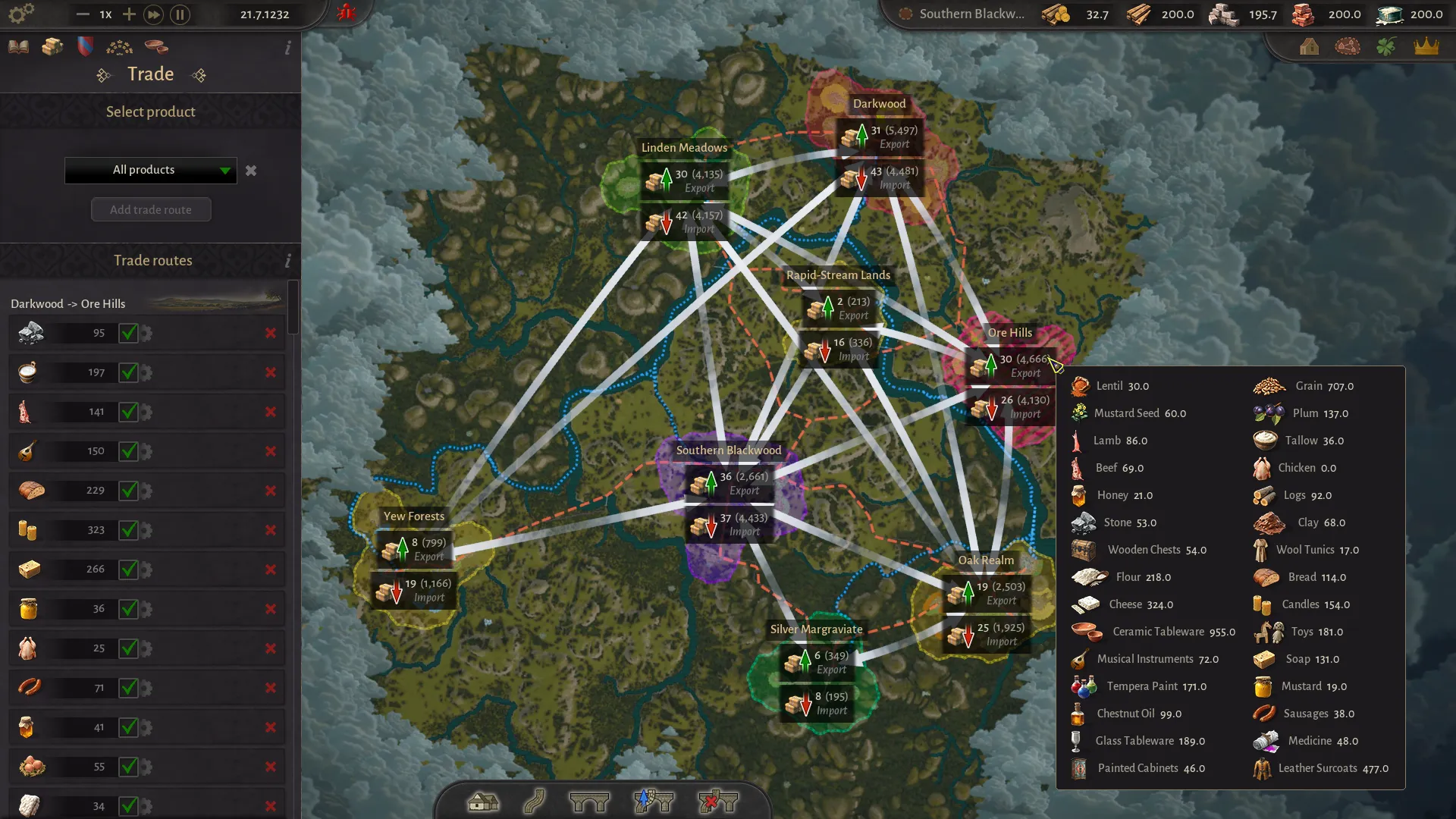
Luxury goods support Artisans and Patricians and are the most profitable trade goods. The demo trade panel lists a wide range, including:
These goods require deep chains and stable input networks. Do not start a luxury industry until the region can spare the workers, buildings and transport. The production guide explains how to plan the inputs.
Goods and trade rules
- Heavy goods — logs, stone, clay and sand — cannot cross regions by road in the demo. Use the river.
- Rafts move downstream only in the demo. Place the producing region upstream.
- Land trade needs a small market in the sending region and a road connection.
- Raft ports need a navigable river and should not sit at a fork.
- Early Access adds ports and sailboats, enabling upstream and downstream trade.
For the full route setup, see the trade routes guide. For the buildings that make these goods, use the buildings reference.
Quick answers
County of Fortune resource questions
What resources are on the County of Fortune map?
The map selection screen shows deposits for stone, clay, iron, sand, limestone and salt. Soil fertility, elevation, climate and river access determine what each region can produce. The demo map is Dragon’s Back; Early Access is expected to add more maps.
What goods can I trade between regions?
Most goods can move by road or river, but heavy goods — logs, stone, clay and sand — cannot be traded between regions by road in the demo. They require a river route. Early Access adds ports and sailboats for bidirectional river trade.
What is the best food to produce?
The best food is the one your land can support reliably. Early on, a single dependable crop is better than three intermittent ones. Later, processed foods such as bread and cheese and composite dishes support higher social classes.
What are luxury goods used for?
Luxury goods satisfy Artisans and Patricians and support higher population tiers. Examples seen in the demo trade list include candles, ceramic tableware, musical instruments, soap, painted cabinets, glass tableware and leather surcoats.